
Debunking the Baccarat Pattern Spotting Myth: What the Math Really Says

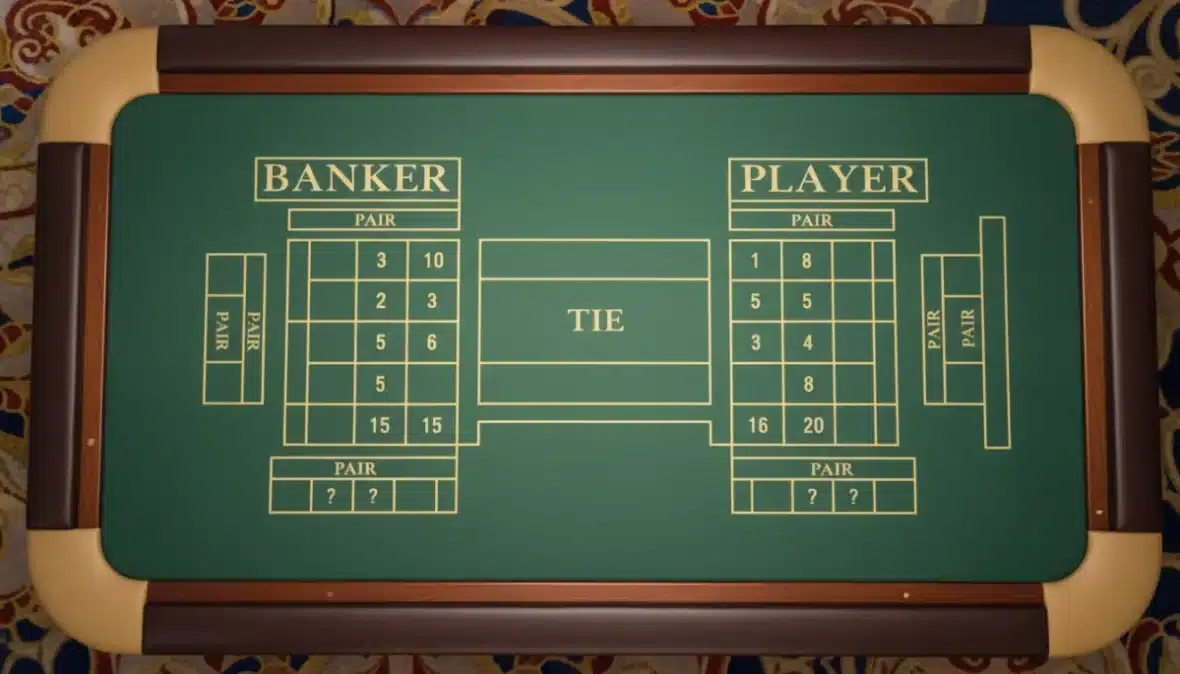
Few casino games inspire as much pattern-tracking devotion as baccarat. Walk into any high-limit room or load up a live dealer table online, and the scene is the same: players hunched over scorecards, eyes flicking to the big road display, searching for the streak that will tell them what comes next. The baccarat pattern spotting myth is one of the most enduring beliefs in gambling, and it survives despite decades of mathematical evidence proving it offers no predictive value whatsoever.
This article breaks down why pattern tracking in baccarat persists, what the math actually shows, and how players can approach the game with a clearer understanding of what does and does not influence the outcome of the next hand.
What Pattern Spotting Looks Like in Baccarat
Baccarat is unique among casino games for the sheer volume of tracking infrastructure built around it. Casinos provide free scorecards. Electronic displays above every table show the recent results in multiple formats. Online platforms replicate the same visual aids in their live dealer lobbies. The most common tracking systems include the bead plate, the big road, the big eye boy, the small road, and the cockroach pig.
Each of these displays takes the raw sequence of Banker, Player, and Tie results and reformats it to highlight different types of regularity. The big road condenses streaks into vertical columns. The derived roads, including the big eye boy and small road, look for repetition or alternation in the big road itself. To the untrained eye these displays look like sophisticated analytical tools. To anyone with a background in probability, they look like a record of what already happened, dressed up to feel predictive.
The Mathematical Reality of Each Hand
The core of the baccarat pattern spotting myth rests on a misunderstanding of independence. In a standard six or eight deck shoe, each hand is, for all practical purposes, an independent event. The cards drawn from previous hands are gone, and while the composition of the remaining shoe shifts very slightly with each round, the effect on the next outcome is so small that it cannot be exploited by ordinary play.
The fixed probabilities for each hand of baccarat sit roughly at 45.86 percent for Banker, 44.62 percent for Player, and 9.52 percent for Tie. These figures hold regardless of what happened on the previous hand, the previous ten hands, or the entire previous shoe. A run of ten consecutive Banker results does not increase the probability that the next hand will favour Player. The shoe has no memory, no sense of balance, and no obligation to correct an apparent imbalance.
This is the essence of the gambler’s fallacy, the cognitive bias that drives most pattern-based betting decisions in baccarat. Players see a streak and feel the universe owes them the opposite outcome. The universe does not.
Why the Human Brain Falls for It
Understanding the baccarat pattern spotting myth requires understanding something about human cognition. Humans evolved to detect patterns because pattern detection had survival value. Spotting a predator hidden in tall grass, recognising the seasonal rhythms of food sources, identifying friend from foe at a distance — these capacities kept ancestors alive. The cost of seeing a pattern that was not real was usually low. The cost of missing a pattern that was real could be lethal.
The result is a brain heavily biased toward finding structure even in genuinely random data. Studies in behavioural economics have shown repeatedly that people misjudge what randomness actually looks like. Truly random sequences contain streaks, clumps, and apparent patterns far more often than intuition suggests. When players see five Bankers in a row, the brain treats it as meaningful information rather than as a perfectly normal outcome of a random distribution.
Casinos understand this dynamic and accommodate it. The presence of pattern-tracking displays at every table is not a service offered out of generosity. It is a recognition that engaged players who feel they are analysing the game place more bets, stay at the table longer, and enjoy the experience more. The displays are accurate. The implication that they are predictive is the illusion.
Common Betting Systems Built on the Myth
Several popular betting strategies in baccarat are built directly on the assumption that patterns matter. The Martingale system, in which players double their bet after every loss, depends on the belief that a winning hand is overdue after a streak of losses. The Paroli system reverses the logic but rests on the same flawed foundation. Trend following systems instruct players to bet with the streak. Trend reversal systems instruct them to bet against it.
None of these approaches change the underlying probabilities. Each hand still resolves at roughly 45.86 percent Banker, 44.62 percent Player, and 9.52 percent Tie. Progressive betting systems can produce short-term wins because variance allows for short winning runs, but over enough hands the house edge reasserts itself with mathematical certainty. A finite bankroll meeting an infinite series of hands at a negative expected value has only one possible long-term outcome.
What Actually Matters in Baccarat Strategy
Recognising the baccarat pattern spotting myth for what it is opens up a more practical approach to the game. The real strategic decisions in baccarat are limited and well understood.
The Banker bet carries the lowest house edge at approximately 1.06 percent after the standard 5 percent commission on winnings. The Player bet follows at around 1.24 percent. The Tie bet, despite its appealing 8 to 1 payout, carries a house edge of roughly 14.36 percent and is best understood as entertainment spending rather than strategic value. Most side bets fall somewhere between the Tie bet and significantly worse, depending on the variant.
Bankroll management is the other lever players actually control. Setting a session budget, defining a stop-loss point, avoiding bet escalation after losses, and treating baccarat as entertainment with a cost rather than as an income source are the practical habits that distinguish disciplined players from those who lose more than they intended.
A Game Worth Playing for the Right Reasons
Baccarat remains one of the most elegant games in any casino. The pace is unhurried, the choices are simple, and the atmosphere at a well-run table has a charm that few other games can match. None of that depends on the pattern spotting myth being true. In fact, players who let go of the search for predictive patterns often find the game more enjoyable, not less, because the pressure to decode a sequence that cannot be decoded is replaced by appreciation for the game itself.
The cards do not care about the streak. The shoe does not owe anyone a correction. The big road is a record, not a forecast. Understanding these facts does not diminish baccarat. It simply puts the player in a more honest relationship with the game, where decisions are made on the basis of probability and personal limits rather than the comforting fiction of a pattern that was never really there.
